
 OneShopLab
The problem every one of your clients has without realizing it
A client calls. Traffic looks fine, ads are running, but sales are flat. They assume it's an acquisition problem. Eight times out of ten, it isn't acquisition — it's the product page.
Most stores you take over have the same defect: flat titles, descriptions that are either empty or copy-pasted from the supplier, zero tags, and raw packshot images on a white background. The visitor lands, feels nothing, leaves. The money spent on acquisition drains straight through that hole.
The problem, for you as an agency, isn't knowing this. It's fixing it at scale. Rewriting 200 product pages by hand is weeks of unbillable work. That's why most agencies don't offer it — even though it's one of the highest-leverage things a client can do.
What the problem actually looks like
Take a real case: a fashion store with a typical pre-optimization product page. The title describes the object, not the benefit. The description is a dry list of specs dumped together. No tags. Decent photos, but no context.
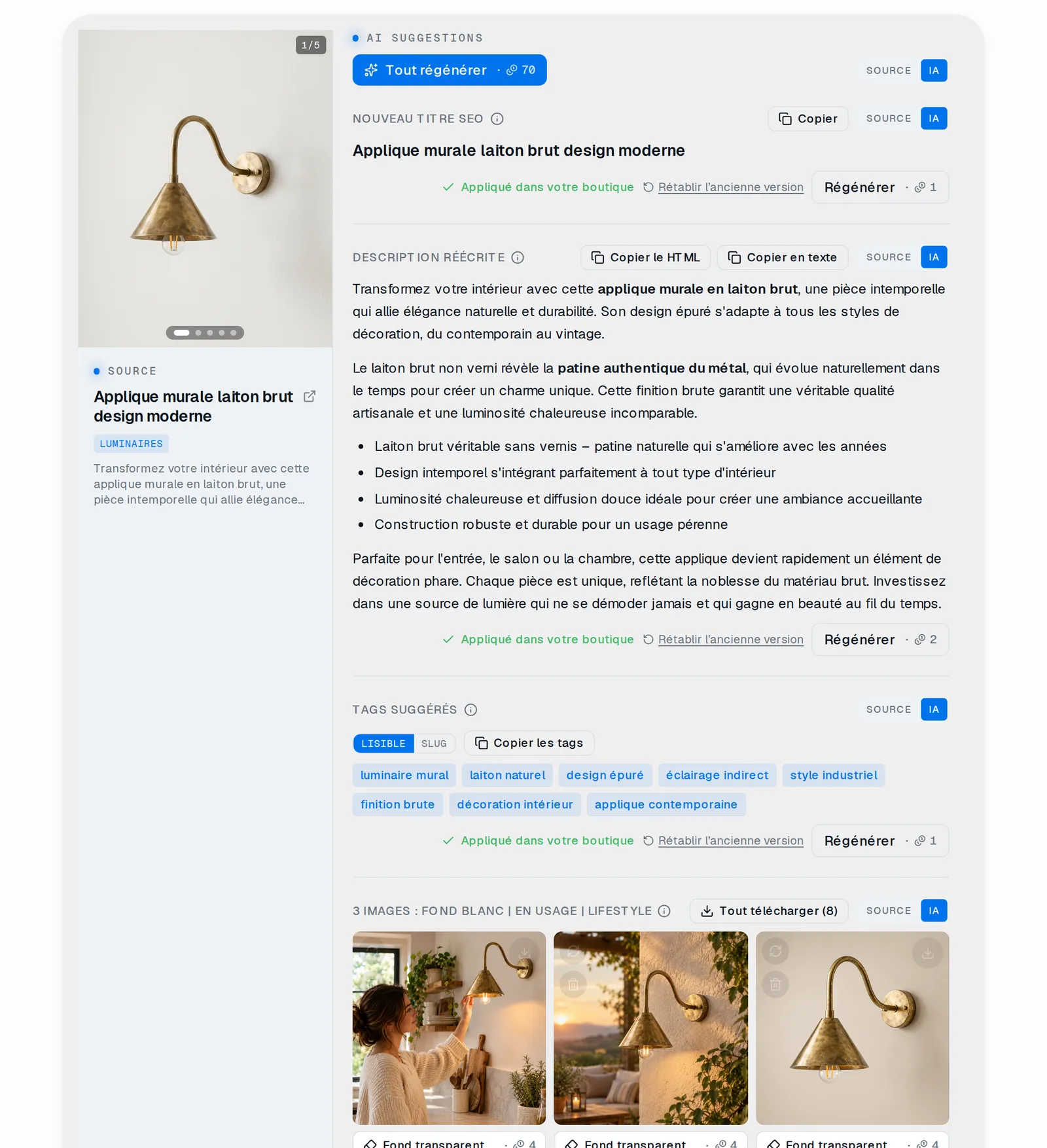
The same product page, before (source) and after one AI optimization pass: title, description, tags and images, each applied or regenerated on its own.
What changes isn't cosmetic. A benefit-led title captures search intent. A structured description handles objections one by one. Relevant tags improve internal navigation and search visibility. Lifestyle visuals put the buyer inside the use case. Each fixed element recovers a fraction of lost sales — and across a full catalog, those fractions add up fast.
Why doing it by hand doesn't work for an agency
The math is simple. A properly rewritten product page (title + structured description + tags + visuals) takes a competent copywriter 30 to 60 minutes by hand. On a 150-product catalog, that's 75 to 150 hours. At your rate, the client will never pay for that, and if you do it on a fixed fee, you lose money.
The result: catalog optimization stays a service nobody really offers, even though the demand is there. That's exactly the kind of blind spot where an agency can differentiate — provided it has a way to do it fast and well.
The method, in three steps
The approach that makes this service profitable rests on one principle: AI does the heavy first-pass work, you keep editorial control and final say. Concretely:
Step 1 — Detect and audit. Start from the store's public URL. The platform (Shopify, WooCommerce, Wix) is detected automatically, and every product gets scored on four axes: copy, visuals, catalog, tags. In about a minute, you have a quantified map of what's wrong. That alone is a deliverable you can put in front of the client.
Step 2 — Pick the model, set the tone. You set the brand voice once ("warm, no superlatives, professional"), site-wide or per product. You choose the text generation model and image quality. The output isn't a generic template: it's built from the product's real attributes.
Step 3 — Generate and apply. You get a new title, a structured description, tags, and three lifestyle photo angles per product. Nothing is pushed to the store automatically: you review, adjust if needed, then apply. For an agency, this is decisive — you never lose control of what goes live on the client's store.
Why this service is especially profitable for an agency
The payoff isn't the same depending on who uses the tool. For a solo merchant, it's a one-off improvement to their own catalog. For an agency, it's a resellable, repeatable service, deployable across every client account on a single subscription.
The effect compounds. A free audit shown to a client becomes a concrete demo: you don't say "your pages are weak," you show the score and the fixed version side by side. That's a sales conversation that nearly closes itself. And what you validate on one client, you deploy on the next without starting from scratch.
How to test the approach this week
You don't need to commit to evaluate whether this holds up. The concrete steps:
- Take an existing client's store — or your own — with weak product pages.
- Run an audit. You get a per-product score in about a minute.
- Generate a full optimization on one or two representative products.
- Compare before and after honestly. Ask yourself one question: would I put this version in front of my client?
If the answer is yes, you've got a service to add to your offering. If it's no, you'll have spent nothing to find out.
Signing up is free, no credit card, with starter credits included — enough to audit one store and run a full optimization on one or two products. That's exactly the volume you need to judge it on the merits.